
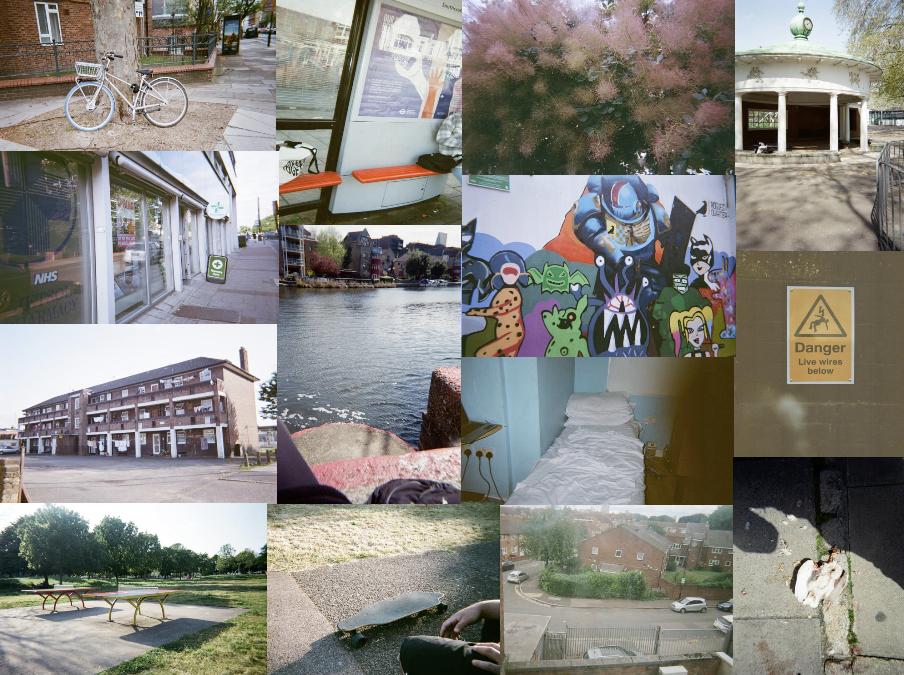
Image description: A collage presenting a selection of the women’s photographs from Sara’s research.
Sara Christou
GFGRG Travel Grant 2025 Recipient
I have had a month to reflect on the 2026 RGS-IBG Annual International Conference in London, and considering the size of the conference, range of sessions, and number of attendees, there’s been plenty to absorb. Firstly, a note of appreciation to the Gender and Feminist Geographies Research Group (GFGRG) for the funding that made it possible for me to attend. It is a difficult time to be an early career researcher, and after four years at university doing a PhD, the sudden withdrawal of support from higher education is a jolt to the system. Thrown into a postdoc world and facing temporary contracts, it can be unsettling having to leave the ‘Institution’ text box empty when registering for conferences and submitting abstracts. Having networks like GFGRG is a vital part of that transition, providing connections and opportunities to access spaces like RGS-IBG, and so I want to extend my gratitude to the GFGRG committee for their support.
This was my first time attending the RGS-IBG conference, and I was excited to join the plethora of different panels, talks and workshops, as well as the anticipation of giving my own presentation. As an interdisciplinary researcher, sometimes you’re unsure which conferences offer the best fit, so over the past few years I have tried to go to a mix of discipline-based conferences. Without doubt RGS-IBG is the one where I felt most at home. Geography is the place to be. I’m already looking forward to next year’s in Bristol, knowing what a welcoming, diverse, and enriching few days await me. In London, I attended some brilliant sessions including: pracademic positionality in feminist research; negotiating emotional geographies of safety and place; crafting and abolitionist geography; geographies of intensity; cartooneering your research; touching visions; pessimist geographies; and the GFGRG lecture. The interactive sessions that involved a creative element were particularly inspiring, and caused me to consider how rarely I make time for arts and crafts in my life, and yet, it is something I am always drawn towards at events like these. During RGS-IBG I embroidered a representation of housing instability, drew a cartoon depicting women’s hidden homelessness, and made a torn collage visualising haptic memory. Ruminating on this, I want to continue exploring creative methods in my own research, as both a mode of inquiry and knowledge generation.
The other joy of this conference were the in-between moments, during a refreshments break, lunch, just after a session and before walking to the next, speaking with other attendees and presenters. These connections matter for an early career researcher in helping to build our networks, and feeling part of a community. It’s in these moments where we share our highlights, critiques, recommendations, and consider how we might take this new knowledge forward into our own work. Making these connections also encourages cross-pollination of ideas into unfamiliar subjects, and you explore sessions that may not have initially been on your radar. If only I could have been in four places at once, because there were too many to choose from. Thankfully, people turned-up to the session I was presenting at—Making Home Over Time: How does time and temporality reshape our understanding of home?,where I discussed my work uncovering women’s hidden experiences of homelessness in London. This feminist participatory research unpacks tacit knowledge from women who have faced crises and continue to evoke their hopes for a future home, and those who have lost hope through the loss of home. A Photovoice study captured these evocations of loss and hope, and in collaboration with the participants, over 150 photographs were contributed (see the above image, a collage of the women’s photographs). The research centres the women as experts by experience, challenging dominant perceptions of homelessness and illuminating women’s narratives through their own words and photographs. I presented the liminality women face when transitioning-out of homelessness, as losing home, homelessness and regaining a sense of home is not a linear experience. It was a wonderful session to be part of, and absorbing insights from the other presenters was highly rewarding. We felt able to cover sensitive topics, showing care and compassion for one another’s work; a meaningful space to be alongside other thoughtful academics. There is deep value in sharing our work, learning from others, making new connections, building a community, and feeling that we belong. This is what GFGRG offers me and many other feminist geographers (and interdisciplinary researchers). I hope to be in Bristol next year, but in the meantime, am open to discussing collaborations and other opportunities.
About the author
Sara Christou (she/her) is an Economic and Social Research Council Postdoctoral Fellow. Her interdisciplinary research uncovers the hiddenness in women’s homelessness through the lens of hope. She completed her PhD at Loughborough University in 2025. Alongside her PhD, Sara hosted The Meaning of Home Podcast, a 17-episode series discussing home and homelessness.
Contact Sara: sara.ar.christou@gmail.com
Listen to The Meaning of Home Podcast: https://open.spotify.com/show/1X4lQQOR6b53Sdp9JqMoTT